Showing newest posts with label 5th grade. Show older posts

Aug 29, 2010

Kandinsky Oil Pastel Circles

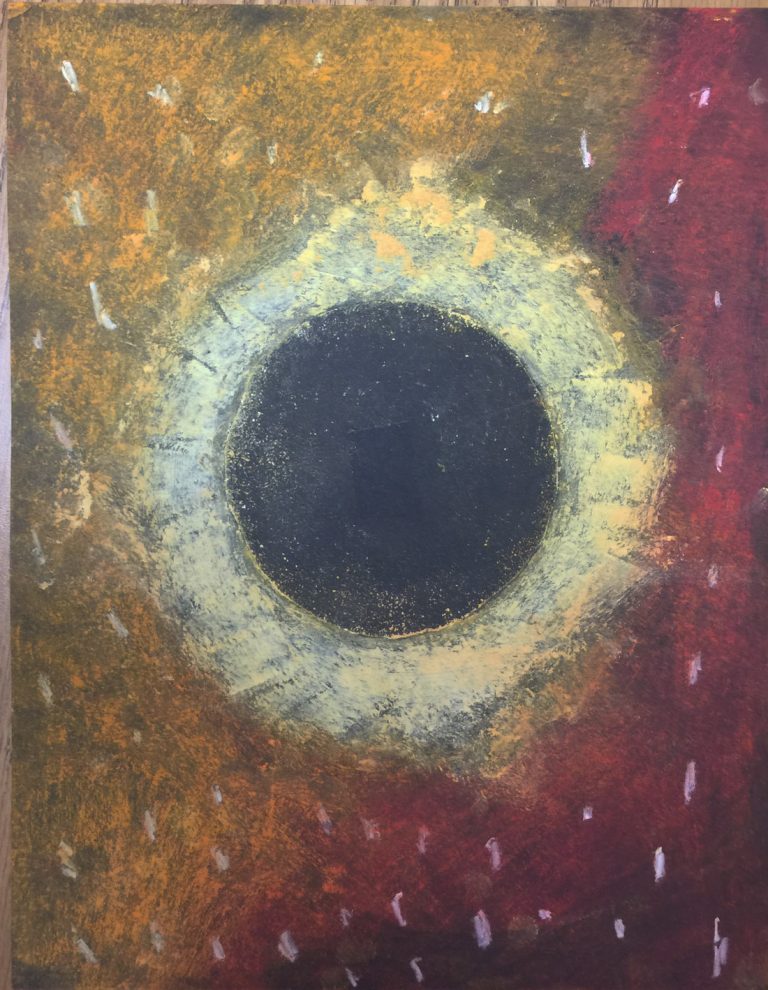
Kandinsky pretty much invented abstract art back in the early 1900's, and his “Study of Abstract Squares” is a fun painting to imitate.
1. Start with a 9" x 12" paper, and have the students fold it in half; and then in thirds so that you have 2 rows of 3 squares.
2. Using oil pastels, students are to make a circle in the middle of each square fill it in. Then they gradually add rings of different colors around it, some thick and some thin until they reach the edge of the square. The corners are filled in as needed.
3. Students continue until all the squares are filled in. Remind them that slow, solid coloring is going to look much better than quick scribbles.
4. Young students may just practice their coloring with a variety of pastels. The 4th and 5th graders could be challenged to use different color theme in each square. For example: warm colors, cool colors, neutral colors, complementary colors, etc.
This art was made by a 2nd grader.

Aug 28, 2010

Plastic Bag Mache Pumpkin

This pumpkin is made from about 40 plastic grocery bags, some Saran wrap, 3 rubber bands, newspaper, paper towel and mache, topped off with a beautiful new orange glitter paint I found at Jo-Ann Fabrics. I'm so excited to have found this beautiful way to recycle plastic grocery bags. For my complete tutorial, click HERE.

Aug 23, 2010

How to Draw a Clown

Clowns takes me right back to black velvet paintings, but the subject matter tends to really bring out the creative side of students. Maybe it’s the permission to be silly, which hopefully of goes without saying when drawing a clown face.
1. I started with a 9" x 13" black piece of paper and pencil. I know it is sometimes a little tricky to see the pencil lines, but using either dark pencils or really dark paper will help. Follow my diagram as follows:
a. Draw a large oval.
b. Draw an upside down hat on top.
c. Add two eyes, a round nose and a single line mouth.
d. Add arches over the eyes and two ears on the side.
e. Starting on the left side of the face, draw the ruffle by drawing down, lots of curves across to the right, and up to meet the right side of the face. Also add a flower coming out of the hat.
f. Add curly hair to fill up the space below the hat and above the ears.
2. Trace all the lines with a thick black oil pastel
3. Color in all the shapes with oil pastel. If some of the black lines are lost, trace again with pastel when complete.

Aug 17, 2010

Watercolor Cityscape

This idea comes from one of the Usborne Book of Arts, which I have expanded upon greatly over the years. The important feature is that students first paint the rectangle shapes, and lastly draw building details on top. The result tends to be so much more creative than if they had drawn the buildings first.
1. Each student needs a sheet of watercolor paper and watercolor paint. I like to dissolve the watercolor tablets to make liquid paint, but trays will work fine too. Have each student paint a series of large rectangle buildings across the paper, leaving a bit of room on the bottom and the top.
2. When complete, they are to paint a background layer of buildings that are all connected, preferably with just one color.
3. A sky is added with some very watery paint that fills in the remainder of the paper. Let dry.
4. With a black Sharpie, the students are to trace their cityscape, and add lots of detail to the exteriors. I’ve had some of my best results with just direct black Sharpie tracing, and if students draw something they don’t like, they can fill it in and just continue.

Aug 16, 2010

Art Journaling 120

Tissue paper not only comes in solid colors, but in multi-color sheets too. I found this madras tissue paper at my local Michael’s store.
1. For my city-slicker students, I like to start with an overview of some common leaf names and shapes so they become more aware of the variety that exist. To start their project, they need several sheets of madras paper cut into approx. 6" squares. If they fold the squares in half, they can cut symmetrical leaves of all shapes and sizes. I always encourage straight cutting without drawing to eliminate pencil lines and eraser holes.
2. When enough leaves have been cut out to fill the paper, the students take 50/50 water and white glue, and wet the entire paper. The cut out leaves are placed gently on top. More solution may be brushed on the tissue to get the entire leaf wet. Some color bleeding may occur. Let the leaves dry completely.
3. I used a bronze marker pen to trace the edges of the leaves and draw veins inside. More line drawing leaves may be added in extra spaces. Lastly, names of each leaf are written around the edges.

Aug 15, 2010

Classroom Colored Pencil Labels

This is just a simple way to make a name label for a student, and could be used many different ways. I find that students tend to use their crayons and colored pencils most often with just one value. Most are just not in the habit of shading with them. These pencils are all made with just one color, using more pressure to make the darker values.
1. I cut tabloid paper into 3 equal sections, roughly 3.5" x 17", one would be given to each student. I drew a vertical line 4" in from the right side for the end of the pencil. A triangle is drawn inside that to make the point of the pencil. Three equally spaced lines are drawn across the length of the pencil. Names are written neatly inside the middle section, and all the lines are traced with a thin black marker.
2. The students are to choose one crayon or colored pencil, and color with the lightest pressure on the top panel, medium on the middle, and heavy on the bottom. The wood can also be shaded with pressure to match the rest. Cut out to make a fun display or leave in panels to label something.

Aug 14, 2010

How To Draw a Bear

I used this bear drawing project a few years ago with not only kinders, but older students as well. They were asked to add lots of fur to their bears, with lines that were all going in the correct direction (away from the face). Good fine motor skill practice.
1. Make sure the students start by drawing a large upside down “U” shape, it should fill most of the paper.
2. A large upside down heart is added in the top half of the face.
3. A smaller “U” is added below the heart, and then a 2nd smaller “U” to make the lip shape.
3. Four or more pointy teeth are drawn inside the mouth.
4. A circle nose sits at the center of the heart, and two circle eyes up above.
5. Two ears are added at the top of the head.
6. Trace all the lines with a dark marker, and then color as desired. Black bears, brown bears, white bears, all will look good, especially if drawn on colored paper with construction brown crayons.

Aug 12, 2010

Paint and Pastel Island House

This is another oil pastel over tempera project that worked well for a multicultural theme a few years ago. A teacher wanted an art project linked to the Bahamas, and this colorful house worked well. I’ve found that when students add oil pastel details over tempera paintings, they end up with a lot more color and detail in their art.
1. The students begin by drawing the angled roof shape in the middle of their paper.
2. The house side is drawn below.
3. The left side of the house is added. Younger students might be better off ignoring the little indents of the roof.
4. A base is added to the bottom house, and also a horizon line.
5. The house, sky and ground are all painted with colorful tempera paint. Let dry overnight.
6. A white pastel may be used to draw clouds, black to make edges on the house, and green to highlight some grass shapes.

Aug 11, 2010

Frank Stella Abstract Drawing

Frank Stella is an American painter and printmaker who has fully embraced the idea that sometimes a painting can just be a flat surface, with no intention of having any depth to it. In the 1960s he created some paintings titled the “Protractor Series” which you can see HERE. For young students practicing geometric drawing, a protractor is the perfect tool to work with.
I like working with coated paper and Sharpie markers, so that is how I created this artwork. The pointy tips on the markers take some patience to color solid areas, so if I had young students (1st through 3rd grade) I would use some blunt tip markers and drawing paper. I’ve also found that limiting the amount of markers students may use (6 or 7?) forces repetition, which can create a kind of color rhythm in their art.
1. Every student will need a protractor and Sharpie, and should make overlapping shapes all over their paper. I would limit them to 6 or so protractor tracings, and that they all need to be either horizontal or vertical. Stella’s art is not freeform or random looking. It’s very clean and orderly and geometric, so that is the look the students should have as a goal.

Aug 9, 2010

Back to School Decorated Pencils

Here’s one quick way for your kids to get creative and personalize their back-to-school pencils. I just pulled out my handy-dandy stash of Sharpies and tried a few different looks: animal skin, flowers and stripes. I’m sure kids could think of many more. Fish scales? Reptile skin?...
1. You may have read on my “Favorite Supplies” list that I prefer Ticonderoga pencils to almost any other brand. Others are often made off-center, or have wood that chews up in a sharpener, or lead that is too light. I like the quality of these, plus the nice yellow color is a good base to work with. The one coloring tip I can offer is that it helps to put your pencil on a little ledge of some kind (I used a book) so that one end can extend over. When coloring with the Sharpie, try to rotate the pencil in the air as you color so that the marker has a few seconds to dry before it touches the paper. The color does set up fast, but if you touch it right when it’s still wet, it will smudge. To make the leopard skin look. I started by making lots of brown spots all over, and then drawing black “C” shapes or “O” shapes all around them.

Aug 8, 2010

Draw a Fish Fossil

I was inspired by a little stock photography image of a fish fossil (see the first thumbnail above) that I found on the internet. Given that 2nd graders in CA have an entire unit on fossils, and the earthy imagery of them can be fun to work with, I tried making a rubbing and resist painting that is based on a simple skeleton drawing. The idea is to have the students draw both the bones and the outside edges of an animal, just the way a fossil looks.
1. I first drew my fish on a heavy piece of paper, and followed the steps shown above. I started with the center spine, added the body around it, and lastly the bones and details.
2. When the drawing was complete, I traced it with white glue and let dry overnight.
3. I placed a sheet of 100 lb. watercolor paper over the glue drawing, and rubbed over it with a dark brown crayon, taking care to turn the paper often so that the lines would show up well.
4. I painted over the inside of the fish with brown watercolor paint, and then the outside with a peach. Other colors could be used, but I would limit the palette to nature colors so that the earthy look doesn’t get lost.

Aug 7, 2010

Modigliana Portrait

Amedeo Modigliani was a late-century European artist who never lived to see his success, but his paintings are some of my all-time favorites. I love his portraits with elongated faces in soulful colors.
1. I started with black paper that was 9" x 15". Give the students a ruler and pencil to draw a line down the middle both ways, and then two more horizontally to make 8 equal sections. The students can start by drawing an oval that centers on the middle line and fills the top half of the paper. Neck lines are drawn down to the next line and then shoulders to the bottom edge.
2. Hair may be added in the style of the student, or the person they are drawing.
3. Modigliana drew his faces in stretched proportions as the eyes usually sit in the middle of the face. The students are to draw their eyes near the top of the head, and the mouth near the bottom. Continue with a nose and eyebrows.
4. Once the portrait is drawn, give the students oil pastels. They need to trace the pencil lines with a black pastel, and then color everywhere else, taking care to color around the black lines. Note: I recommend doing this project after you have done one that involves normal facial proportions.

Aug 3, 2010

Creative Writing Project

I’m on a mission to find the most creative projects for my curriculum this fall, and have decided to reapproach this creative writing/drawing project from a book titled “Things that are Most in the World” by Judi Barrett. I tried it’s suggested followup a few years ago, but now have a more specific idea on how to have students push things a bit further.

Each page in this book is based on a different adjective, such as “The teensie-weensiest thing in the world is a newborn flea” or “The prickliest thing in the world is the inside of a pin cushion”. The end of the book just suggests that you have students come up with their own “most” creation, but lacks the guide on how to have them really exaggerate things. What I plan to do now is first ask the students to choose their adjective (prettiest, softest, bumpiest, etc.) Then they need to think of two things with those qualities, and put them together. For example, if they chose “prettiest” they need to think of two pretty things and combine them somehow. So maybe they think princesses are pretty, and say beauty pageants are pretty, so their sentence could read “The prettiest thing in the world is a princess beauty pageant.” It’s a formula that’s been around awhile, but I think could be pretty effective in creating some very funny combinations. And from funny ideas, hopefully come funny drawings.

One more idea: collect all the pages from your class to make one big book book, and go to www.tikatok.com/classroom to get hardcover copies made. Haven't tried it yet, but they are connected to Barnes & Noble and their prices start at just $2.99 each.

Click HERE to get my blank template for this project.

Jul 28, 2010

Dubuffet Cow Drawing

Jean Dubuffet painted “The Cow with a Subtile Nose” in 1954, and I’ve always wanted to see how close I could get to the look with a good old crayon and watercolor resist. I do recommend that you have your students use a light color for the cow, and a dark watercolor to get the most contrast for their wrinkles.
1. To draw the cow, first start with a large square with rounded corners. Older students may be able to follow the placement on the paper.
2. The feet and udder are added below.
3. A neck is extended from the body and a long head is added. Ears are drawn on the side.
4. Eyes and nose are added to the face.
5. The tail is drawn on the back. Lastly parts of the rectangle are erased so it looks more like a cow body.
6. The drawing is traced with a black Sharpie, and colored very heavily with crayon.
7. The paper is crumpled up, opened up and smoothed. Repeat 3 or 4 times.
8. Dark watercolor paint is generously spread over the entire painting.
9. Rub a paper towel over the entire picture to smooth. Moooove to a drying rack and enjoy!

Jul 27, 2010

Monogrammed Stationary

I saw this idea in an old library book, and thought it was a really nice application of your basic crayon rubbing project.
1. I started with a lettersize piece of chipboard, but any heavy paper would do. I drew my initials in block form, and cut them out of the heaviest paper I could find. Card stock works well to make a definite edge.
2. Glue the letters down with a glue stick.
3. Place a regular sheet of paper on top and rub away with one or more crayons. Rotating the direction of the rubbing helps to make all the edges really appear.
4. Write a nice old-fashioned letter to someone you care about. Thank you notes are always appreciated!

Jul 25, 2010

City Block One-Point Perspective Drawing

One of the CA Arts Standards for 5th graders is one-point perspective drawing. To be honest, I’ve struggled with covering this concept in the past with just one 50-minute class. After discussing what it means to have a “vanishing point” in their drawing, I once had students make their own guidelines to follow, only to have much of the class not get past this point. And I once tried pre-printed guides, only to find they get confusing and end up being too much information that can’t be erased. This year I’m going to try starting with this series of squares, which you can download here. I think it will give students the angles they can see to follow their own vanishing point, without overwhelming them with too many lines.
1. Just the fronts of their buildings are drawn in each square, leaving room for the rest of the building.
2. A vanishing point can be inside a picture or outside, which is true for this guide. The students should visually follow where all the angled lines on their guide would intersect off the paper so they can picture where their vanishing point is. The sides of each building are drawn, making sure that they all point to this imagined vanishing point. The sides of the city blocks will help guide them.
3. The ends of the buildings are connected to finish the buildings. It’s best, of course, to start with just simple cube-shaped buildings before more complex ones are taken on. Some blocks may just have trees, if desired.
4. All of the drawing is traced with an ultra fine point marker, and colored in with pencil crayons.

CA Visual Arts Standard: Grade Five
2.1 Use one-point perspective to create the illusion of space.

Jul 23, 2010

Andy Warhol Soup Cans

Andy Warhol’s Campbell’s Soup Can painting has come to symbolize the pop art movement.
WEEK 1: Give the students a 9" x 12" sheet of paper, along with a 5" wide oval template that is the shape of the top of a can (in perspective). Show them how to trace one oval at near the top of the paper, slide the oval down about 7" and trace again. Connect the outside edges, erase the curve that will not show, and add the same curve to the middle of the can. After this, it is helpful for them to look at a Campbell's label to add details in their own style. I encouraged students to make up their own “flavor” and to cover all their pencil lines with a thin black marker.
WEEK 2: Prep work is needed here. Each student’s art needs to be xeroxed down 50%, and then duplicated 4 times. The students will then take all 4 copies of their original art, paste them down in a grid, and colored them in with colored pencils.

Jul 22, 2010

Another Popsicle House

I’m still loving these little popsicle sticks, and made a variation of my other house project I posted here. This one has a more vertical, paneled look instead of the horizontal, log cabin look.
1. These little popsicle sticks I found at JoAnn Fabric’s, and are about 2 1/2" long. I started by lining up six sticks, and cut the ends off of two more so they could be glued to the back without showing as shown in diagram 1.
2. The roof starts with a frame as shown in diagram 2. Let dry.
3. Cut progressive ends off three more sticks so they can fill in the roof as shown. Let dry.
4. Glue and attach roof to house as shown and let dry.

Jul 20, 2010

Dubuffet Self Portrait

Jean Dubuffet (1901-1985) was a French painter and sculptor who preferred what he called “raw art”. This came from non-professionals who worked in very primitive ways. He routinely added sand, tar and straw to his paintings to give them an unusual texture. His playful style is fun to imitate and can encourage some very creative portraiture.
1. Start by sketching a large simple drawing of yourself on a sturdy piece of paper. No tiny details, just outline of hair, eyes, nose, shoulders, etc. Draw a few horizontal and vertical lines on the body, hair and face to divide up the areas into smaller parts. Keep in mind that the lines will be traced with a glue bottle so tiny details are not necessary.
2. Make a mixture of 50/50 white glue and black acrylic paint in a squirt bottle, and shake to blend. Trace over all the pencil lines with the black glue. Remember that Dubuffet liked rough looking images so wiggly black lines that are sometimes thin and sometimes thick are what you are trying for. Let the glue dry overnight.
3. A lot of Dubuffet’s paintings were done with just red, white and black colors, so I limited myself to a red and black Sharpie, and randomly added stripes in some areas, and solid colors in others. Some spaces may also just be left white.

Jul 19, 2010

Recycled Mosaic Picture Frame

I love the look of stone mosaic art, but it is expensive and not really practical for young kids. I thought I’d try a variation of this idea I saw online using old plastic cards instead. Between gift cards, rebate cards, and club cards, it’s pretty easy to collect these without really even trying.
1. I started with 8 jumbo popsicle sticks, and glued them together with white glue as shown. Let dry.
2. Cut several plastic cards with a scissors into strips that are just a bit thinner than the width of the stick. Cut across the strips to make the most even and equal-sided squares that you can. Glue these onto the frame with white glue, leaving a small amount of space on either side.
3. If you like the frame with the round ends showing, stop and find or make some art for the center. I wanted a more modern look so after the squares were dry, I used a large scissors to cut the ends off flush.
4. Fill your frame with a photo, drawing, or your favorite quote. To hang, apply a stick-on hanger (available at most craft stores) on the back.

  © Blogger templates The Professional Template by Ourblogtemplates.com 2008

Back to TOP